Best Way to Preserve Family Memories Digitally (Before They're Lost)
Most of your 3,000 photos this year will never be looked at again. Here's the best way to preserve family memories digitally — and why you need both a digital system and a printed book.

TL;DR: The best way to preserve family memories digitally is to combine ongoing curation with physical backup. Upload and review your photos monthly (not annually), capture context beyond just images, and print a book as a permanent record. Most people’s approach — dumping 3,000 photos a year into a camera roll and hoping for the best — means 85% of those memories will never be looked at again. LifeCache is an AI-powered photo book app that automatically turns your phone photos into beautiful printed yearbooks and event books, solving both the digital and physical sides of preservation.
Here’s a number that should bother you: the average person takes about 3,000 photos a year. They look at maybe 15% of them ever again. The rest sit in a camera roll, slowly becoming meaningless as the context — who was there, why it mattered, what was happening in your life — fades from memory.
We’re the most-photographed generation in history. We’re also the worst at doing anything with those photos.
I spent four years trying to fix this for my own family before I realized the problem isn’t storage. It’s curation.
Why isn’t your camera roll enough?
Your camera roll stores photos. It doesn’t preserve memories.
There’s a critical difference. A photo of a beach tells you almost nothing two years later. Was it a vacation? A random Tuesday? Who were you with? What was happening in your life that month?
Photos without context decay. The image stays sharp, but the memory behind it gets fuzzier every year until it’s just… a nice picture of a beach.
Your camera roll has no structure, no narrative, no way to capture what was happening beyond what the lens saw. It’s a storage system, not a preservation system.
Why isn’t social media preservation?
Some people treat Instagram or Facebook as their memory archive. “It’s all on my feed.” Three problems with that:
1. Algorithms decide what survives. Social platforms bury old content. Your posts from 2022 are effectively invisible unless someone deliberately scrolls back. The algorithm optimizes for engagement, not your memories.
2. Platform risk is real. MySpace lost 50 million songs. Vine shut down entirely. Facebook could change its terms tomorrow, or your account could get locked. Building your family memory archive on rented land is a gamble.
3. You only post the highlights. Social media captures the moments you want others to see, not the moments you want to remember. The Tuesday night pizza. The messy living room on Christmas morning. The random sunset from your commute. Those are the memories that matter most in 20 years — and they never make it to Instagram.
Do you need both digital and physical preservation?
Yes. And here’s why.
Digital gives you scale and searchability. Thousands of photos, organized, accessible from any device. You can browse, search, share instantly.
Physical gives you permanence and presence. A printed book on your shelf gets opened. It’s tangible. Kids flip through it. Grandparents hold it. It exists independently of any app, any account, any company staying in business.
The ideal system does both: curate digitally, print physically.
What’s the best system for preserving family memories?
After four years of trial and error, here’s what actually works:
Monthly curation, not annual panic
The single biggest mistake people make is waiting until December to deal with their photos. By then, you’ve forgotten half of what happened. The context is gone. You’re left sorting through thousands of photos trying to reconstruct a year from timestamps.
Monthly is the only cadence that works. Review one month while the memories are still fresh. It takes five minutes. Do it on the first weekend of every month.
Capture context, not just images
Photos are the skeleton. Context is the flesh. Every month, answer a few simple questions:
- What was the highlight?
- Best meal you had?
- What were you watching or reading?
- A moment you want to remember?
These tiny bits of text are worth more than another hundred photos. In 10 years, “March 2026: finally finished renovating the kitchen, Leo started Little League, obsessed with that Korean drama” will trigger a cascade of memories that photos alone can’t touch.
Print annually
Digital is fragile. Hard drives fail. Cloud services shut down. Formats change. A printed book on your bookshelf will outlast every digital storage system you’re currently using.
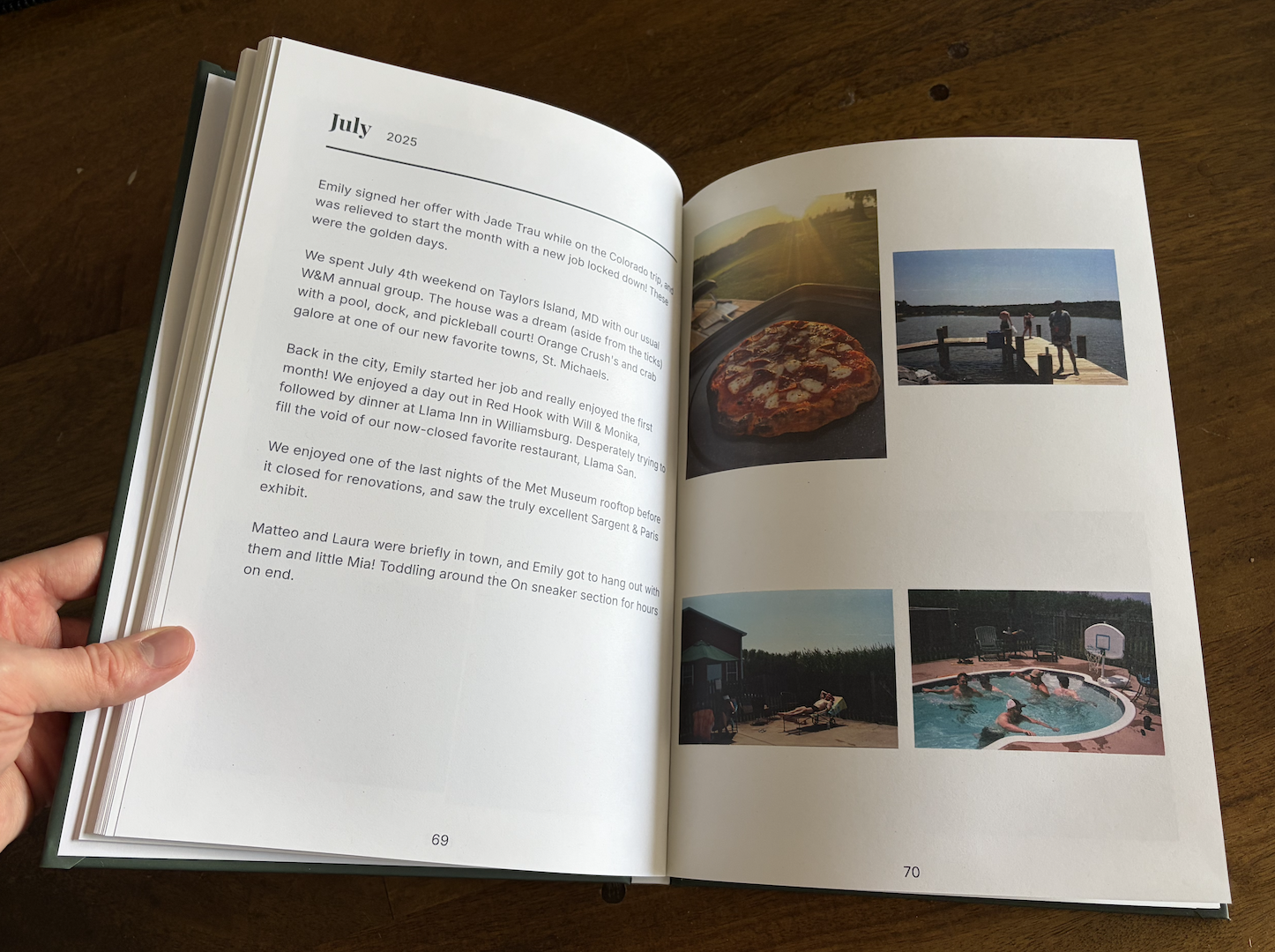
LifeCache produces hardcover yearbooks printed on premium stock with professional binding. But even if you use a different service — Shutterfly, Mixbook, whatever — the point is: print something. Every year. Make it non-negotiable.
How does LifeCache handle memory preservation?
LifeCache was built specifically around this problem. Here’s how it works:
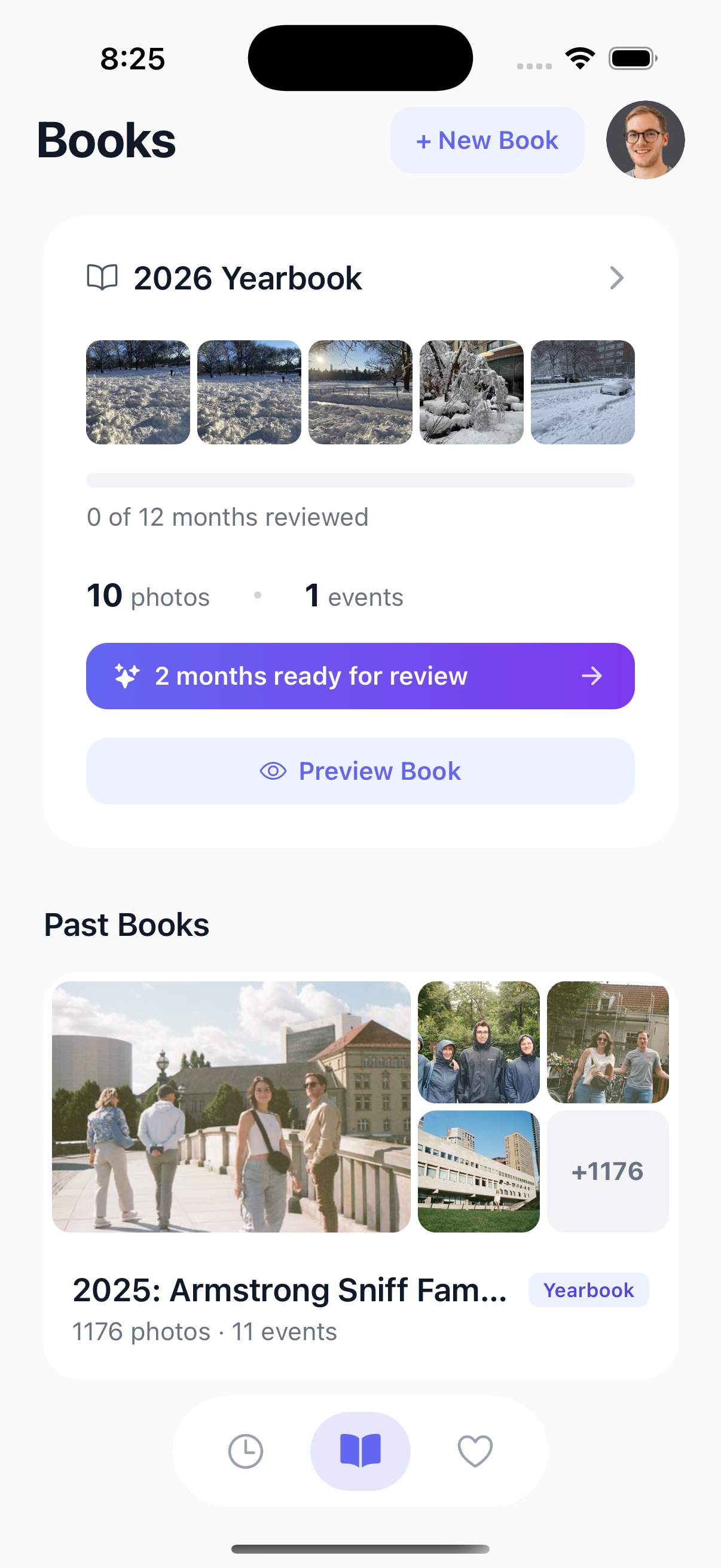
AI curation: Upload your month’s photos from your iPhone camera roll. AI analyzes timestamps and GPS data to group photos into events — a weekend trip, a birthday dinner, a regular Tuesday at the park. Each event gets a title, highlighted photos, and an AI-generated description.
Monthly prompts: After reviewing your photos, you answer prompts that capture the non-visual texture of your month. These get woven into your yearbook alongside the photos.
Year-over-year timeline: LifeCache builds a continuous timeline of your life. Compare the same month across different years. See how your family changed, where you traveled, what mattered to you.
Print on demand: At year’s end, order a hardcover or softcover yearbook. Or share a private digital version with family — no account required.

A membership is $59.99/year with 25% off every printed book. There’s a 7-day free trial. Hardcover books start at $39.99.
What about older photos and past years?
Good news: you can upload photos from any year in your camera roll. The AI uses the embedded timestamps and location data to organize them, even years later. It works best when done month by month, but you can bulk-upload a past year and the AI will sort it.
For truly old photos — printed snapshots, film negatives — scan them first using an app like Google PhotoScan, then upload the digital versions. The scanned photos won’t have GPS data, but timestamps from the original print dates can still help with organization.
How do you start preserving memories today?
Sign up for LifeCache and upload last month’s photos. Five minutes. AI handles the rest.
Then set a monthly reminder and do it again next month. And the month after.
In a year, you’ll have a complete record of your family’s life — curated, contextualized, and ready to print. In ten years, you’ll have a shelf of yearbooks that tell the story of how your family grew.
The photos are already on your phone. The only question is whether you’ll do something with them before the context disappears.
Frequently Asked Questions
What is the best way to preserve family memories?
The best approach combines monthly photo curation with context capture and annual printing. Upload and review photos monthly while memories are fresh, capture context through prompts (highlights, favorites, milestones), and print a physical yearbook annually as a permanent record. This preserves both the images and the stories behind them.
How do I preserve family photos digitally?
Start with cloud backup (iCloud, Google Photos) for raw storage. Then use a curation tool like LifeCache to organize photos into events, add context, and build a structured timeline. Raw cloud storage keeps your files safe, but curation is what makes them meaningful and accessible years later.
Are printed photo books still worth making?
Yes — printed books are the most durable form of photo preservation. Digital formats change, cloud services can shut down, and hard drives fail. A printed book on your shelf will be accessible in 50 years without any technology. It’s also the format that actually gets looked at — people flip through books in a way they don’t scroll through cloud albums.
How many photos should I keep per month?
For a family yearbook, 15-30 curated photos per month is the sweet spot. That’s enough to capture the key moments without overwhelming the book. LifeCache’s AI selects 5-10 highlights per month automatically, which you can adjust during the review step.
What’s the difference between LifeCache and Google Photos or iCloud?
Google Photos and iCloud are storage services — they keep your files safe and searchable. LifeCache is a preservation and printing service — it takes your photos, organizes them into events, captures context through monthly prompts, and produces a printed yearbook. They’re complementary: use iCloud/Google Photos for backup, LifeCache for curation and printing.
Can I preserve memories for someone else, like my parents or grandparents?
Yes. You can create a LifeCache yearbook as a gift. Upload photos from shared albums or your own camera roll, curate the highlights, and order a printed book. It’s one of the most meaningful personalized gifts you can give — a year of someone’s life, beautifully documented and printed.